The term 'postdigital' describes how everyday life and our surroundings are permeated by digital technologies.
In this context, the distinctions between digital and non-digital, between old and new media, between being
online and offline, become increasingly blurred. In the field of publishing, experimental practices explore
the combination of hardware and software to produce content that results in hybrid forms. As Alessandro Ludovico
points out, these hybrids are a new kind of publication that results from the integration of a software component,
of content production through automated processes, and an analog printed component which frames and contextualizes it,
seamlessly integrating the two realms (print and digital).
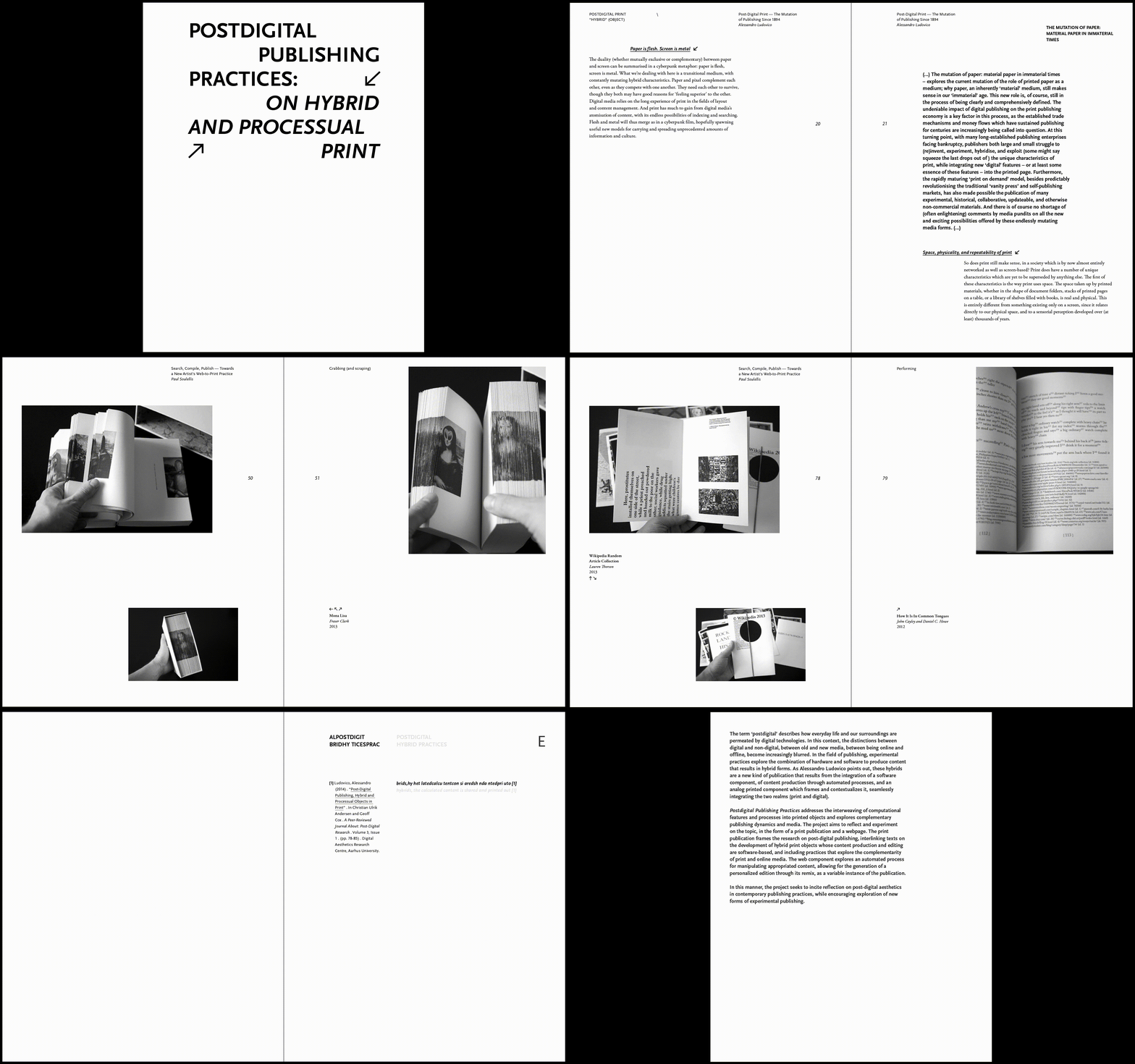
PostDigital Publishing Practices addresses the interweaving of computational features and processes into printed objects and explores complementary publishing dynamics and media. The project aims to reflect and experiment on the topic, in the form of a print publication and a webpage. The print publication frames the research on post-digital publishing, interlinking texts on the development of hybrid print objects whose content production and editing are software-based, and including practices that explore the complementarity of print and online media. The web component explores an automated process for manipulating appropriated content, allowing for the generation of a personalized edition through its remix, as a variable instance of the publication.
In this manner, the project seeks to incite reflection on post-digital aesthetics in contemporary publishing practices, while encouraging exploration of new forms of experimental publishing.
Access the print publication here
Why and what for?
- To explore a hybridized editorial structure through a methodology marked by design experimentation;
- To reflect on the implications of computational processes on publishing practices and how these can shape the meaning and intention of editorial projects. To promote new typologies of hybrid printed artifacts and to explore new publication dynamics.
Additional info
The variable elements of the generated publication are typographic style, text size and construction of the grid, which are algorithmically defined. There is a rule for every compositional element:
- Texts should not overlap which each other;
- Typefaces of the book should be complementary;
- Maximum and minimum column widths should be manipulated in text transition.
If one of these rules applies a book gets generated.
Who made this?
Web Development, graphic design, content selection and generator application that compiles the contents ~ Alexandra Guimarães
Context:
Project II , Laboratory II
Master's in Communication Design . 2021-2022
Faculty of Fine Arts of the University of Lisbon
This is an experimental academic project with the purpose of exploring content manipulation for the creation of new publications. The copyright of all textual contents used on the website and generated publication belongs to the respective authors.
Special thanks to
Luísa Ribas and Pedro Ângelo (Project Advisors)
Beatriz Querido, Marco Alpoim, Mónica Faustino and Pedro Pereira
PostDigital Publishing Practices addresses the interweaving of computational features and processes into printed objects and explores complementary publishing dynamics and media. The project aims to reflect and experiment on the topic, in the form of a print publication and a webpage. The print publication frames the research on post-digital publishing, interlinking texts on the development of hybrid print objects whose content production and editing are software-based, and including practices that explore the complementarity of print and online media. The web component explores an automated process for manipulating appropriated content, allowing for the generation of a personalized edition through its remix, as a variable instance of the publication.
In this manner, the project seeks to incite reflection on post-digital aesthetics in contemporary publishing practices, while encouraging exploration of new forms of experimental publishing.
Access the print publication here
Why and what for?
- To explore a hybridized editorial structure through a methodology marked by design experimentation;
- To reflect on the implications of computational processes on publishing practices and how these can shape the meaning and intention of editorial projects. To promote new typologies of hybrid printed artifacts and to explore new publication dynamics.
Additional info
The variable elements of the generated publication are typographic style, text size and construction of the grid, which are algorithmically defined. There is a rule for every compositional element:
- Texts should not overlap which each other;
- Typefaces of the book should be complementary;
- Maximum and minimum column widths should be manipulated in text transition.
If one of these rules applies a book gets generated.
Who made this?
Web Development, graphic design, content selection and generator application that compiles the contents ~ Alexandra Guimarães
Context:
Project II , Laboratory II
Master's in Communication Design . 2021-2022
Faculty of Fine Arts of the University of Lisbon
This is an experimental academic project with the purpose of exploring content manipulation for the creation of new publications. The copyright of all textual contents used on the website and generated publication belongs to the respective authors.
Special thanks to
Luísa Ribas and Pedro Ângelo (Project Advisors)
Beatriz Querido, Marco Alpoim, Mónica Faustino and Pedro Pereira